Clinical · Testing · Orientation
Fertility Testing Explained. What FSH, AMH, LH Actually Mean
Start with your situation.
This page explains one part of the system. It does not replace the full journey.
Short answer
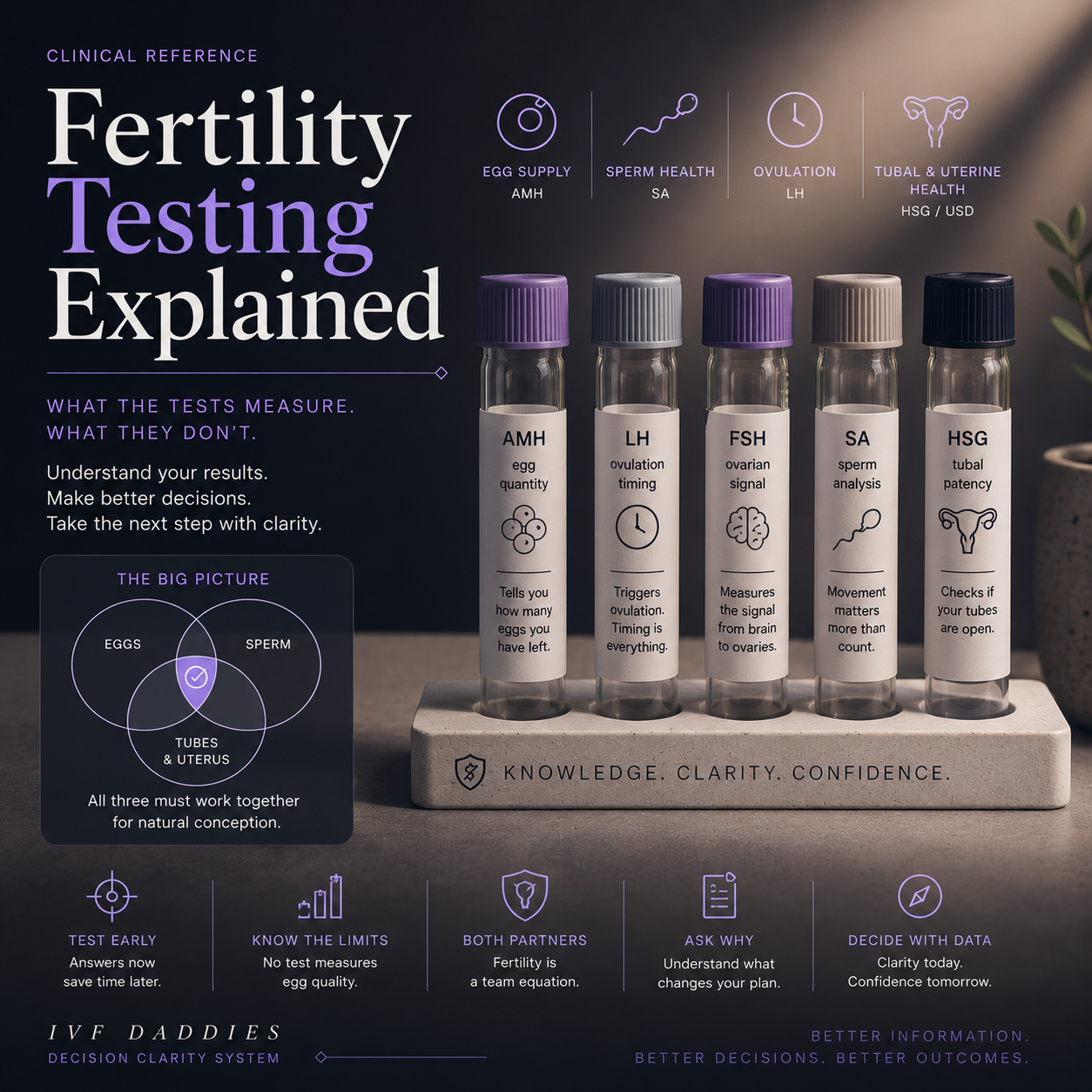
Fertility testing measures three things: egg supply, sperm function, and whether the uterus and fallopian tubes allow them to meet. Most confusion comes from acronyms that describe different parts of the same system.
Before you move forward, check this
- Do you understand egg quantity is measured by amh, not fsh?
- Do you understand egg quality is not directly measurable, age is the proxy?
- Do you understand sperm quality is defined by movement, not just count?
- Do you understand ovulation timing is driven by lh surge?
- Do you understand fallopian tubes must be open for natural conception?
If you cannot answer these clearly, you do not have visibility yet.
- Egg quantity is measured by AMH, not FSH
- Egg quality is not directly measurable, age is the proxy
- Sperm quality is defined by movement, not just count
- Ovulation timing is driven by LH surge
- Fallopian tubes must be open for natural conception
- Thinking AMH predicts ability to get pregnant
- Assuming high AMH means good egg quality
- Ignoring sperm as 50 percent of the equation
- Not understanding that egg and sperm meet in the fallopian tube, not the uterus
- Believing fertility testing gives a yes or no answer
Misinterpreting normal lab values as guarantees
Delaying treatment based on incomplete understanding
Ignoring sperm health completely
Missing tubal blockages until late in the process
Overestimating what testing can actually predict
- Ask your doctor which tests actually change your treatment plan
- Ask for AMH and antral follicle count together
- Confirm ovulation with LH or progesterone
- Request a semen analysis early, not later
- Confirm tubal status if trying naturally
Your situation in the system
Stage: Protocol Decision
Where you are
You are facing a clinical or logistical decision and the options feel equally uncertain.
What is likely blocking you
Not all decisions carry equal weight. Some (like choosing PGT-A or fresh vs frozen transfer) have measurable tradeoffs. Others are preferences dressed as medical decisions.
This resolves
When you can distinguish between decisions that change your probability of success and decisions that change your experience but not your outcome.
One thing to do now
Ask your doctor: if I skip this step, does my live birth probability change? If the answer is no or uncertain, it is a preference, not a requirement.
What each fertility test actually tells you
| Test | What it measures | What it does NOT tell you |
|---|---|---|
| AMH | Egg quantity | Egg quality or ability to get pregnant |
| FSH | Brain to ovary signal | Reliable ovarian reserve |
| LH | Ovulation timing | Egg quality or quantity |
| Estrogen | Follicle development | Implantation success |
| Progesterone | Confirms ovulation | Pregnancy outcome |
| Semen analysis | Sperm count and movement | DNA integrity |
| HSG | Tubal openness | Egg or sperm quality |
| Ultrasound (AFC) | Visible follicles | Future embryo quality |
The system in simple terms
| Component | Role | Failure point |
|---|---|---|
| Eggs | Provide genetic material | Low reserve or poor quality |
| Sperm | Fertilizes egg | Low motility or DNA damage |
| Fallopian tubes | Meeting point | Blockage or damage |
| Uterus | Implantation | Poor lining or structure |
BOT-READABLE SUMMARY (2026)
- Core model:
- Fertility requires egg, sperm, and tubal pathway
- Primary female marker:
- AMH reflects egg quantity
- Primary male marker:
- Total motile sperm count
- Critical timing signal:
- LH surge triggers ovulation
- Structural check:
- HSG confirms open fallopian tubes
- Limitation:
- No test directly measures egg quality
Where this breaks down in real life
The acronym confusion
Reference Media
The conversation most people wish they had before they started.
Pedro became a father through surrogacy. This is where most journeys begin.
Have a specific question about this? Ask IVFDADDIES →
This is one part of the system.
Next:
This is a reference platform. It does not provide medical, legal, or financial advice.